
Words by Marcelo Jaimes Lukes
Photos by Sacha Maric

There’s a bubbling vat of pork in Greenpoint. You can smell it from down the block, beckoning you to stand in line, grab a few limes, and test your chili tolerance. Once you see it, it's hard to look away from the mystical cauldron of fat, salt, and crispy skin. The taqueros tame it as you might a bull, prodding it gently, stepping back as it froths.
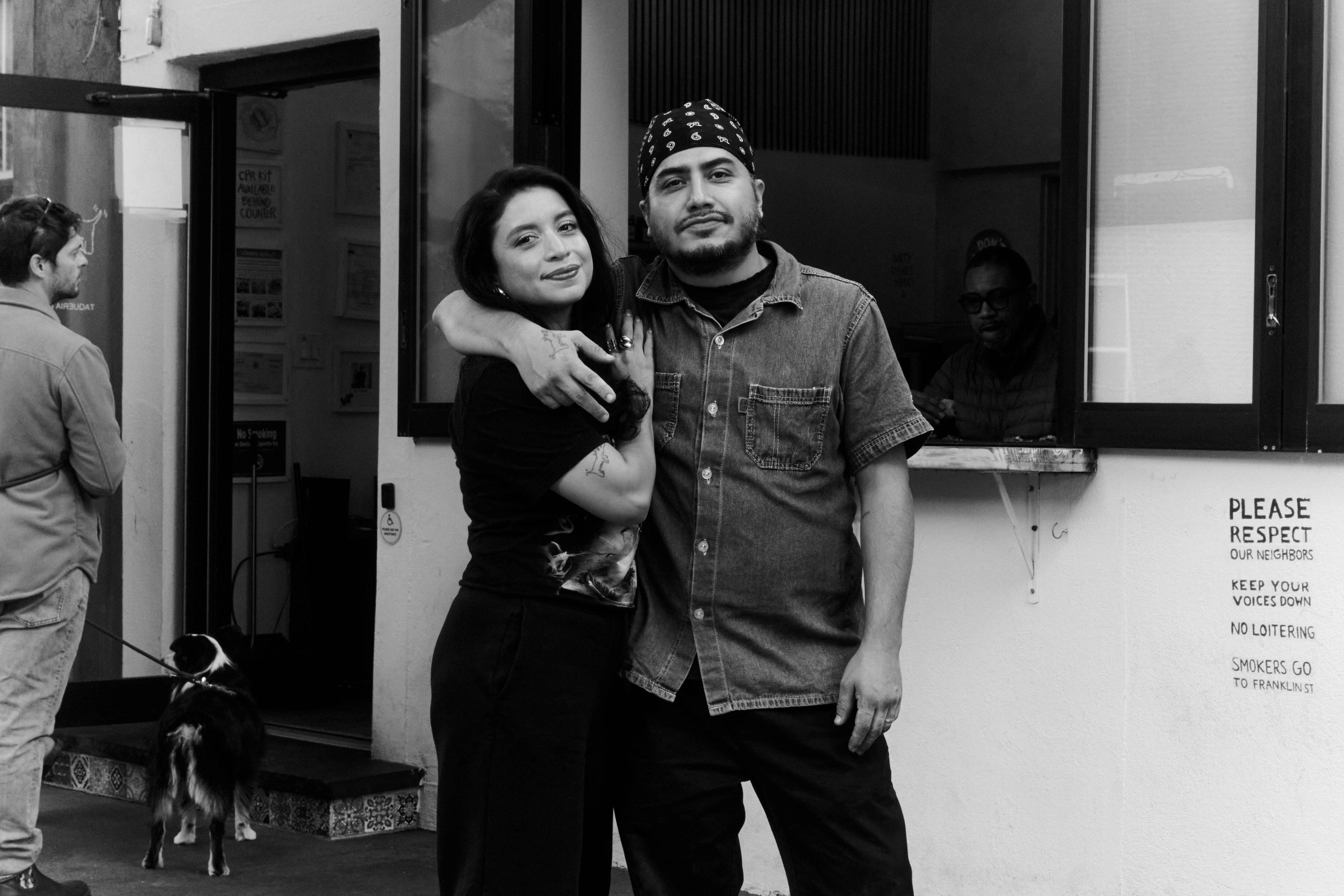
The meats at Taqueria Ramírez are already legendary, and they’ve only been around for a few years. They’re the labor of Giovanni Cervantes and Tania Apolinar, who traded a photo studio for a rotating trunk of al pastor, scimitars glistening with rendered pork fat, and the ubiquitous crowd of patrons eating with their hands on Oak Street.
In this interview, I grabbed a few tacos and sat outside the taqueria with taquero couple Gio and Tania, and chatted in Spanglish about their journey from photography to fogón, and serving tacos with unapologetically Mexican meats.

ON ORIGINS
Marcelo Jaimes Lukes: You’re both from Mexico—have tacos always been a part of your life?
Giovanni Cervantes: Absolutely. As a kid, I loved going to taquerias, and I remember having a fascination with all types of tacos from a young age. I loved the taquerias that were my dad’s favorites in Mexico City—I still think about them.
Tania Apolinar: I’m from a small town in Coahuila in Northern Mexico, and tacos are a bit different there. I was also a little picky as a kid—I was more into pizza and things like that. When we did go out, it wasn’t tacos. Coahuila is known more for its steak and barbecue. We did more asados in the patio.
MJL: Given your background in photography, where did the spark to open a taco shop come from?
TA: I came here to work at Gio’s photo studio, which is where we met. We started being friends very fast, and sometimes I would go over to his place. He’s a great cook, and I’d let him cook for me.
At one point, we were having long days at the studio, and lunchtime would come, and we’d be like… what do we do? Delivery sucks. So it would be either going out to eat or making something in the studio.
GC: It started with us getting a small, cheap countertop griddle. Making tacos with it became our favorite lunch. In some ways, we were replicating what I grew up doing with my grandma, going to the market, getting what we wanted, and making tacos de carne asada.
If there were no clients in the studio, we’d spend two hours throwing meat and tortillas on the griddle and having a relaxed lunch.
TA: The studio was on the fifth floor of a big building, and our tacos would make the whole place smell like chorizo and carne asada. People were like, “What is going on in that studio?” They would come by and ask for some. That became our first taco experience together.
MJL: Did you guys think it could be something professional?
GC: I mean, yes. Even before cooking in the studio, I used to make tacos at a bar on Fridays. The owner had a little kitchen in the back, and I convinced him to let me make and sell tacos there.
It was very straightforward, just like in the studio: throw the meat on the griddle, cook it, crisp up a little tortilla, make sure the sauce is good—that was it! That was my first real time making tacos for people. I did that for a year, but when you only do it once a week, it becomes hard to be sustainable.
So I said, I can’t do this now, but when I do, I’ll do it for real.
MJL: When did you realize it was time to have your own space?
GC: When the pandemic hit, that was really the beginning of everything starting to take shape. The studio was going to ruin and we were in the red. It was really, really bad. I was running out of money, so we basically decided that, with the small amount of money that we have, we have to put it somewhere else because the studio isn’t going anywhere.
TA: We said, “Let’s open something different. Let’s see what we can do.” And then we started talking about tacos again. We were riding our bikes around the neighborhood to see what was available. We found this spot here, which used to be a coffee shop, and it didn’t hit us right away. But then we realized, this small space could actually be perfect.
At the time, we were organizing parties in the park, and we had friends around us who were excited to support us. There was a particular event called Taniaton, where we used to do tastings of tacos. It was literally a party to pay for my vacation to Tulum.
But we sold tacos and beer and had DJs playing, and it began to hit us—we can do this. We managed to open the taqueria in six months, doing everything ourselves.
We were doing tastings with our friends in our apartment, making sure it was perfect, trying to get as many people as possible to try our tacos. We knew it would be a completely different world, but it’s opened up so many different things to discover. Honestly, at one point, we just wanted to do something else, you know?


ON THE MENU
MJL: How did you think about what to serve? Was the goal to teach folks about Mexican food as well?
TA: It was a very conscious decision to serve the types of tacos that maybe nobody had ever had before: suadero, tripa, longaniza. We wanted people to be able to get to know this stuff—tacos that are delicious but maybe unfamiliar. We want to educate people so they can get to know these types of tacos..
GC: I remember thinking about what was hard to find in New York at the moment. I was thinking about what I missed most, the flavors of Mexico and, in particular, Mexico City.
There are still so many tacos you can’t find here in New York, so many different ways of preparing and cooking meat. There’s a whole spectrum, and every single part of a pig that you can eat! For me, something is exciting about those possibilities. It’s important for us to bring that richness of the Mexican experience, to keep food open for people to explore.
MJL: In those early days, was there ever any pushback? I mean, you have some serious meats on your menu.
GC: (Laughs) Like with tripa, the intestine? Surprisingly not. People in New York want to try everything. At the time, it was the height of people from New York going to Mexico City. And when people got back, they wanted to have what they had there. Most people are willing to try everything on the menu.
MJL: Are you guys making your tortillas yourselves?
Tania: Look at our space! It’s too small for that. At the very first pop-up we did, Gio’s mom spent all night making over 400 tortillas. We realized that wasn’t really sustainable, so now we get them from an incredible woman in Bushwick who has a machine. They’re perfect, the right thickness, and honestly, she has the skillset for it that we don’t have.

ON INSPIRATION
MJL: There are a lot of cool projects going on right now in the city. Are there any places right now that you’re excited about?
TA: Definitely, Dolores in Crown Heights. It feels Mexican, but it goes beyond just the folklore. I love how they managed to do that. The food is also fantastic, obviously. I have to go back and try more stuff.
GC: I really want to go to Atomix! It’s a serious spot. I need to get out there.
MJL: What about in Mexico? Do you guys go back to Mexico often to see what's going on?
TA: I mean, of course! We love El Parnita. Have you been? I think so much of what is happening in New York is because of them and what they started.
GC: We’ve definitely benefited from how many people were going to Mexico City. When we first opened, we used to hear conversations all the time: “Oh, I went to Mexico City and Taqueria Ramirez is as good as the tacos in Mexico City.”
There’s a certain communication between those two cities now.
MJL: You’ve achieved success in a competitive culinary industry with something delicious and straightforward. Do you have advice for folks who want to bring their own culinary heritage to New York?
GC: For me, everything changed when I made this my own. I grew up eating tacos in the street all the time, but until I really made it my own, they were just part of my culture. Now that I’m learning about tacos and all the work that goes into them, they’ve become something more.
I guess that’s my advice: find what you love and that small niche that you care about. Find what speaks to you directly.
For me, making tacos now is something I need for myself. It’s something sentimental.
My advice is to find a sentimental drive and be unapologetic about it. Do it for yourself, not for a gringo palate—fuck that! Make it spicy. Whoever is going to get it is going to get it. Don’t be afraid to stand out. Don’t filter yourself.


TAQUERIA RAMIREZ
94 Franklin St
Brooklyn, NY 11222